
.png?%20Views%20Images%20(47).png&width=3750&height=1959&name=PR%20News%20%26%20Views%20Images%20(47).png?%20Views%20Images%20(47).png)
Industry
Manufacturing
Challenge
A 24/7 manufacturing facility required guaranteed heating reliability, but its LTHW system ran continuously at a fixed temperature, wasting energy and reducing boiler efficiency.
Results
A low-risk, demand-led control strategy delivered a 77% improvement in efficiency, significantly reducing energy use and costs while maintaining comfort, reliability, and uninterrupted manufacturing operations.
Key Product
DL Insight
“After Demand Logic was selected as the energy management solution, it became immediately evident that with the new data we could enhance building efficiency without compromising operational requirements, even in such a critical environment. I was particularly impressed by how the platform made both the obvious issues and the more complex aspects transparent and accessible to all stakeholders.”

Project Summary
Demand Logic’s partnership with Siemsatec focused on improving the efficiency of the LTHW system at Alcatel’s 24/7 manufacturing facility, grounded in a shared understanding of the critical nature of the environment and the careful planning required for any operational change. Through detailed system analysis, open communication, and a joint commitment to risk-free improvement, the teams worked closely with Alcatel to understand existing performance and identify opportunities for smarter, demand-led control.
This collaborative approach enabled a carefully planned and smoothly delivered revision to the control strategy, introducing demand-based enabling and optimised setpoint control that reduced unnecessary system operation and improved boiler efficiency without affecting comfort or manufacturing conditions. The immediate, positive results demonstrated the power of unlocking operational data and leveraging strong stakeholder collaboration to achieve meaningful, low-risk performance gains in complex industrial settings.
Operational Challenge,
Data-Driven Opportunity
Alcatel’s 24/7 manufacturing facility required continuous heating to guarantee
operational certainty, but the LTHW system ran constantly at a fixed 70°C, wasting energy and reducing boiler efficiency. Using real-time insights from the Demand Logic platform, the team revealed when spaces actually needed heat, how much thermal output was being generated, and how underloaded the system often was. This data highlighted a clear opportunity to adopt a demand-led approach.
Working closely with Siemsatec, Demand Logic designed a low-risk, demand-driven control strategy. Primary and secondary systems were enabled only when needed, setpoints were optimised to meet actual downstream demand, and a revert option via the BMS ensured operational confidence. The implementation was carefully scheduled during the summer to mitigate any potential disruption.Demand Logic’s partnership with Siemsatec focused on improving the efficiency of the LTHW system at Alcatel’s 24/7 manufacturing facility, grounded in a shared understanding of the critical nature of the environment and the careful planning required for any operational change. Through detailed system analysis, open communication, and a joint commitment to risk-free improvement, the teams worked closely with Alcatel to understand existing performance and identify opportunities for smarter, demand-led control.
This collaborative approach enabled a carefully planned and smoothly delivered revision to the control strategy, introducing demand-based enabling and optimised setpoint control that reduced unnecessary system operation and improved boiler efficiency without affecting comfort or manufacturing conditions. The immediate, positive results demonstrated the power of unlocking operational data and leveraging strong stakeholder collaboration to achieve meaningful, low-risk performance gains in complex industrial settings.
Smarter Systems,
Measurable Results
The new strategy quickly delivered real-world benefits. The heating system ran only when it was needed, reducing waste while keeping the facility comfortable and fully operational. Alcatel saw noticeable reductions in energy use and operational costs, all without compromising reliability.
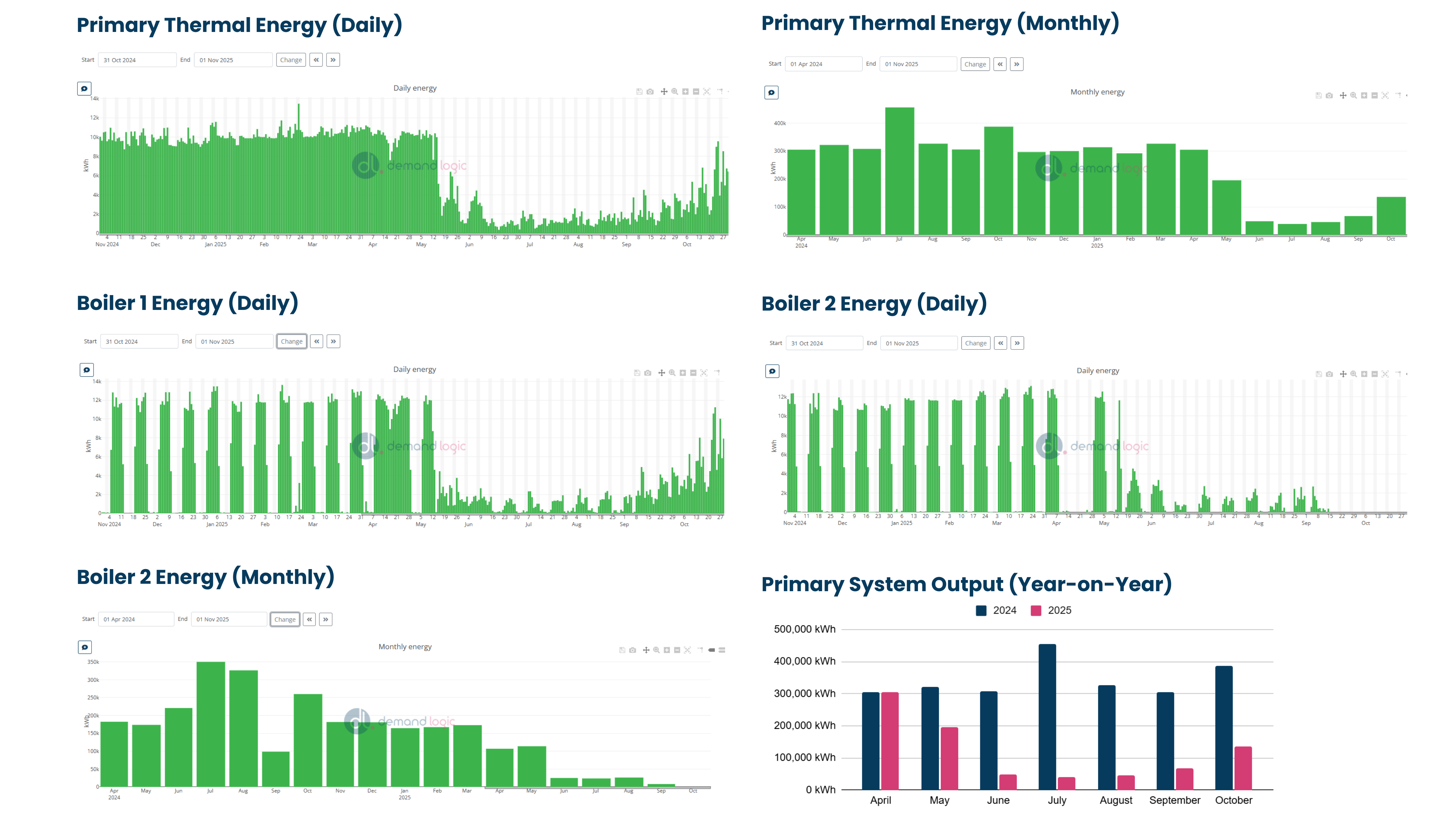
Performance was monitored at regular intervals to track the impact of the new approach. The results show consistent, significant energy savings over time, proving that smarter, demand-led control can deliver lasting improvements in efficiency and cost.
| Analysis Period |
Timeframe | Comparison Basis | Reduction Achieved | Thermal Energy Saved (kWh) |
| 14 days | Same period before and after modifications |
Before | 63% | 89,267 |
| 6 weeks | After | 77% | 325,353 | |
| 3 months | April - June | Year on Year | 84% | 385,450 |
| 7 months | April - October | Year on Year | 64% | 1,572,448 |
| 5 months | June - October | Excluding pre-reconfiguration data in 2025 |
81% | 1,445,837 |
"The journey we have been on since Demand Logic was introduced to our facility has been very positive. Demand Logic have advised on a number of areas and ways in which to reduce our energy consumption and improve efficiency of our plant using and analysing the data gathered from the platform.
In particular, the optimisation of our LTHW system, following credible advice and assurances of a strategy change being effective, we proceeded with confidence, the results have been remarkable and has reduced our gas usage dramatically. This project is a key milestone on our roadmap toward carbon reduction and achieving net zero, while also reducing utility costs. These have been executed professionally in collaboration with Siemsatec and the team at ASN with remarkable results, all without any disruption to our plant and critical environments."- Steven Golden, Building Services Engineering Manager, Alcatel
Optimising Efficiency:
Daily Energy Comparison
These graphs show the thermal energy of the primary system and individual boilers over the past year, clearly illustrating the before-and-after effects of implementing Demand Logic and highlighting the significant decrease in energy use alongside improved system efficiency achieved through the demand-led control strategy.